To Which Tree Will Humanity Again Have Access at the End of the World
Why has humanity destroyed such vast forests? And how tin can we bring this to an end?
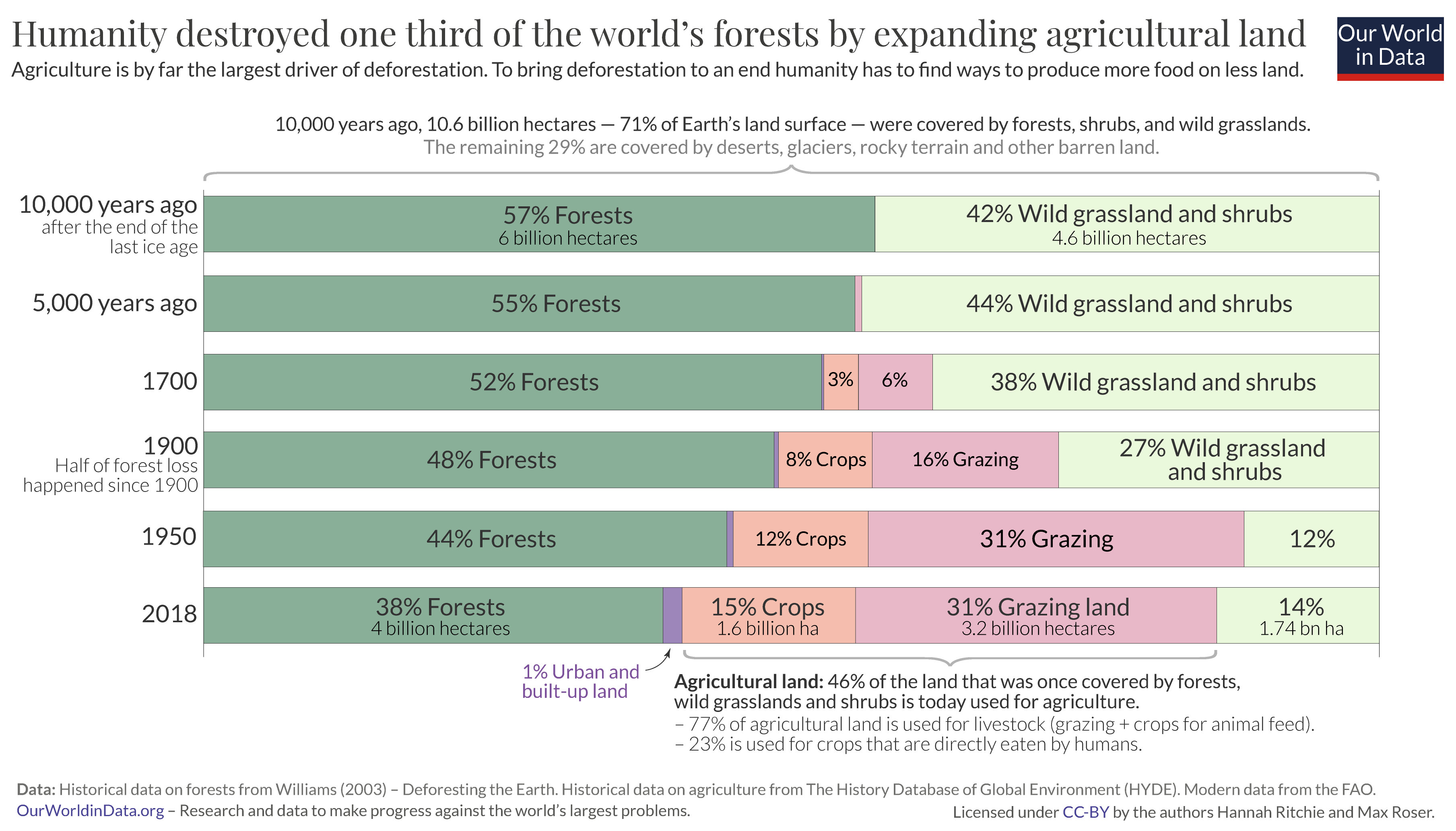
For thousands of years humans have destroyed forests. At the end of the last great ice age, an estimated 57% of the world's habitable state was forested.1 Since then, people in all regions of the world take burned and cut down forests. The chart shows this. The forested country area declined from 6 to iv billion hectares. That means our ancestors destroyed i-third of the former forests – a forest area twice the size of the U.s.a. was lost.
At that place are two big reasons why humans take destroyed forests and go along to do so – the need for land and the need for wood:
- We need wood for many purposes: as construction material for houses or ships, to turn it into newspaper, and – most importantly – equally a source of free energy. Burning wood is a major source of free energy where at that place are copse but no mod free energy sources bachelor. Still today nearly one-half of extracted forest globally is used to produce energy, mostly for cooking and heating in poor households that lack alternatives.ii
- By far, the most important driver of the devastation of forests is agriculture. Humanity cuts downwards forests primarily to make space for fields to grow crops and pastures to raise livestock. We as well cut down forests to make space for settlements or mining, but these are small in comparing to farming.
The land utilize for farming did not but come at the expense of the world's forests, merely also led to the huge refuse of the earth's other wild spaces, the shrub- and grasslands. The chart shows this likewise.
In many countries forests continue to be destroyed. The series of charts shows this. In all of these countries the forest embrace today is lower than three decades ago.3

Most of the forests that are destroyed today are in the torrid zone, some of the almost biodiverse regions on our planet. Why is this happening?
The following chart shows what is driving the ongoing destruction of the world's largest tropical wood: the Amazon. The expansion of agricultural country to raise cattle is the most important driver, by far.iv
I wish this was more widely understood. Land use for agronomics is the main threat to the earth's biodiversity.v
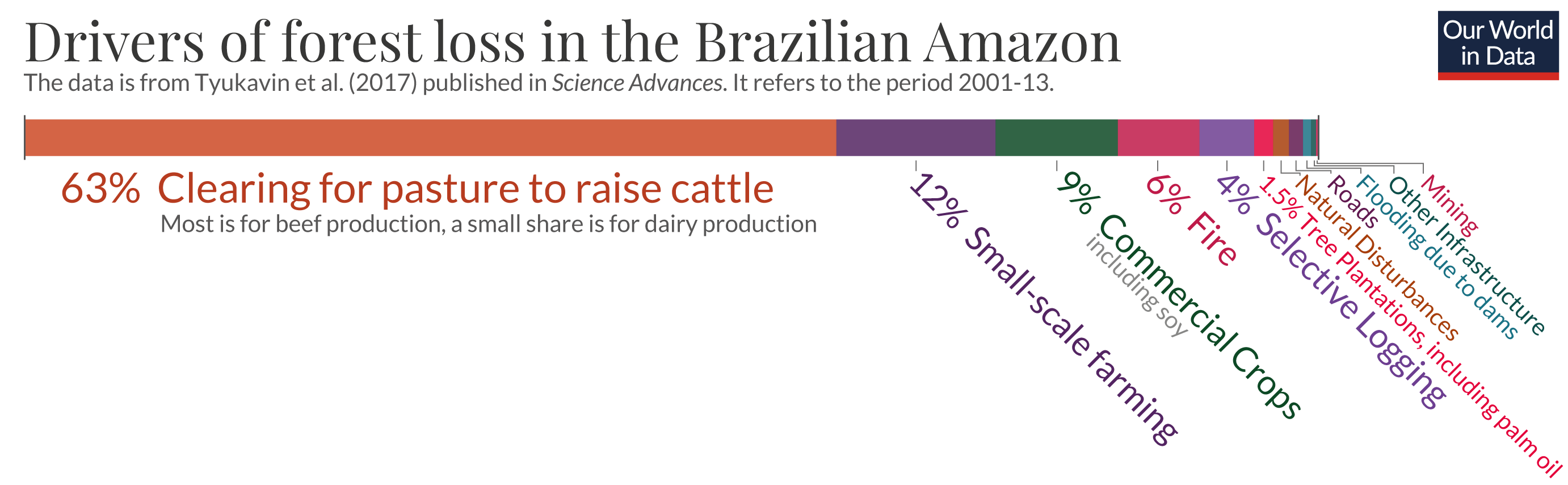
Most of the destruction of tropical forests is due to consumers in the region, merely nigh 12% of the deforestation in the tropics is driven by demand from high-income countries. Beef-eaters around the globe are contributing to the destruction of the Amazon rainforest.half-dozen
This huge bear on of meat consumption on deforestation is too visible in the showtime chart that showed the history over the final 10 millennia – 31% of the world's habitable land is at present grazing country for livestock. This is an extremely big part of the world; taken together it is as large equally all of the Americas, from Alaska in the N down to Tierra del Fuego in the S.
Meat consumption is such a large driver of deforestation because information technology is a very inefficient way to produce food. The state use of meat production is much higher than plant-based foods. Reducing meat consumption is therefore a style to increment the agricultural output per land area. A shift away from the land-intensive production of meat, especially beef, would be a major way to make progress and end deforestation. 1 possible mode to get there is to make articulate how large the environmental bear upon of meat product is. Some other – complementing – way is to produce meat substitutes that people prefer over beef.
The finish of deforestation?
Afterward thousands of years of deforestation is there whatsoever hope that it could exist dissimilar?
Yes.
In fact there are many countries that brought their history of deforestation to an cease. Several even turned it effectually so that forests there are now expanding.
This reversal, from deforestation to reforestation, is called a Wood Transition. The chart shows the data for some of the countries that have accomplished this.7
Equally mentioned before, while information technology is the case that several countries have achieved this transition, information technology is also the instance that consumers in these countries contribute to deforestation elsewhere.

Crucial for these turnarounds was technological progress that reduced the need for fuelwood and agronomical land.
- The demand for wood as a source of energy decreased when modern energy sources became available – initially fossil fuels, and more than recently renewables and nuclear power.
- The need for more and more than agronomical land decreased when existing farmland was used more efficiently – when an increase in food production was achieved by a higher output per expanse of land.
The increased productivity of the country thanks to modernistic agriculture allowed more and more countries to spare the forests that would otherwise be converted into agricultural land. Innovative mod crops, fertilizers, pesticides and irrigation make this increment of ingather yields possible.
These ii technological changes can be complemented by constructive policies and regulations. Zero-deforestation policies restrict deforestation and programs like REDD+ of the FAO compensate poorer countries and farmers to make forest protection economically more bonny than deforestation.viii
Tin we achieve a Global Forest Transition in our lifetime?
If we desire to protect our planet's forests the globe equally a whole would need to attain what many countries take achieved already, the turnaround from deforestation to reforestation – a global forest transition.
Countries around the world take made the terminate of deforestation their explicit goal: At COP26 in Glasgow, countries with about 85% of the world's forests pledged to stop deforestation by 2030.
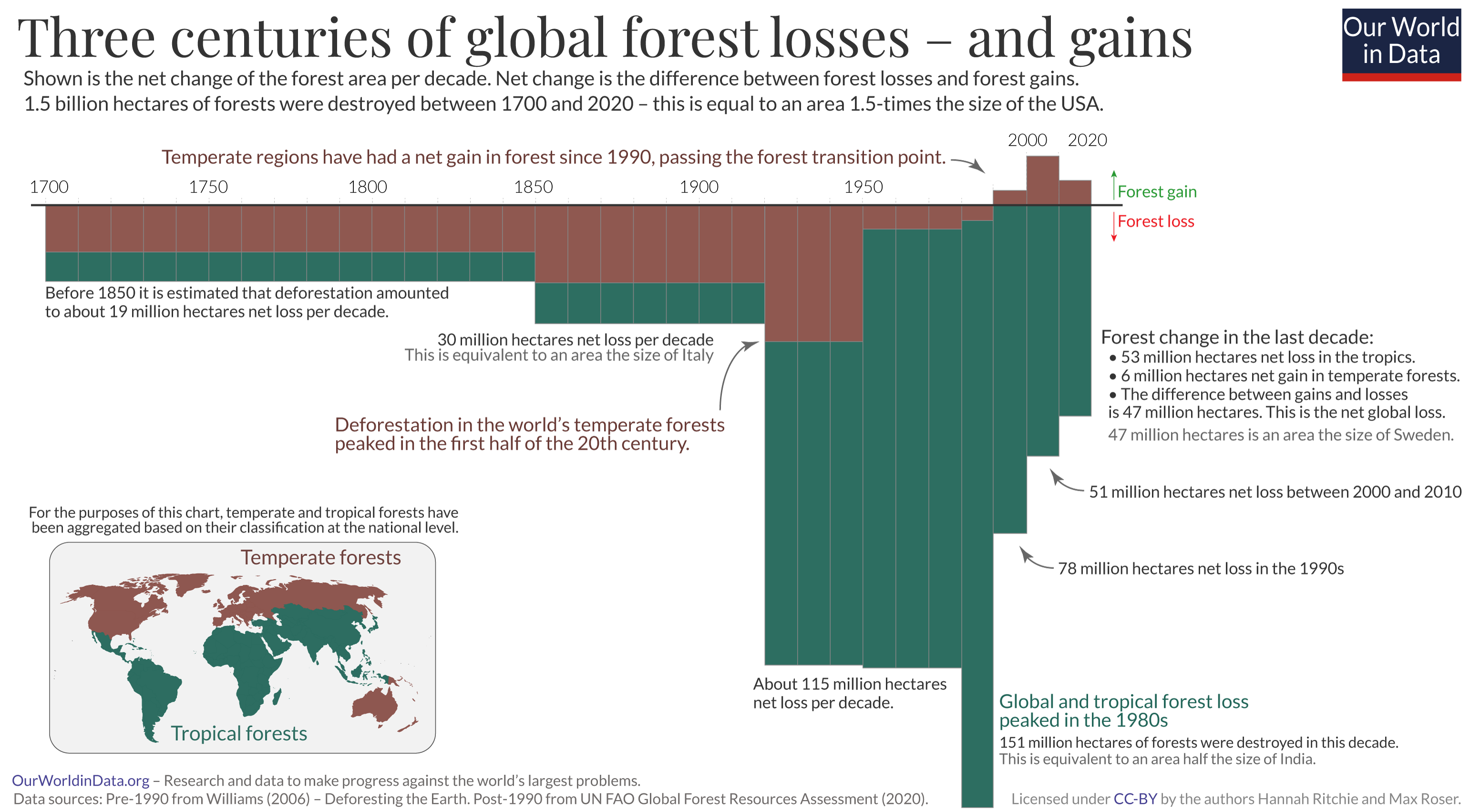
The last chart shows where the globe is in this try.
The dark-brown part of the chart shows the history of the temperate forests. These forests equally a whole have accomplished the transition: deforestation was high in the past, then peaked in the first half of the 20th century, and from the 1990s onwards temperate forests have expanded in size. Temperate forests are growing back.
The challenge is now to achieve the same in tropical forests, which are shown in dark-green. We are making progress in this management: the rate of deforestation in the torrid zone was highest in the 1980s. Since then, the rate of deforestation has declined past a factor of three.
If we can further decrease the demand for fuelwood and agronomical country it seems possible to bring deforestation in the tropics to an end.
If we achieve the global woods transition in our lifetimes it would exist a major success for the protection of the earth's biodiversity. Additionally it would bring greenhouse gas emissions from deforestation to an end, and expanding, rather than shrinking, forests would instead suck more carbon out of the atmosphere.
We tin become the first generation that achieves a world in which forests aggrandize
How tin we bring deforestation to an cease? There is no single answer, just, as we have seen, a few big changes tin can bring this large goal into achieve.
More productive agriculture that allows more production on a smaller state area, a shift away from meat, constructive conservation policies, and a shift to mod energy sources: by bringing all of these factors together we could become there. Not only would we salve existing forests from existence cut down, we might also free upwardly space for forests to grow dorsum.
In our lifetime we have the unprecedented opportunity to bring our long history of deforestation to an end. For the first time in millennia we could attain a globe in which forests expand.
Continue reading on Our World in Data:
Humanity's relation to other mammals on our planet is in many ways like to the history told here. Wild mammal populations have declined over the last thousands of years, but we can plow things around and achieve a time to come in which they flourish.
Acknowledgements: I would like to thank my colleague Hannah Ritchie for her helpful comments on this essay.
Source: https://ourworldindata.org/global-forest-transition
0 Response to "To Which Tree Will Humanity Again Have Access at the End of the World"
Post a Comment